
Deception is the Point
It matters more than you think

In 1943, Allied Commanders understood that an invasion of Europe was the only option to ensure the defeat of Nazi Germany in WWII. The issue was that Nazi Germany also understood this. The Allies had one clear option of invasion, the northern coast of France. However, other, less expected, options existed. Rommel, the Commander of German defenses recognized the beaches of Normandy look remarkably like those of Salerno, Italy and began trying to get the Nazi high command to prepare.
This is why the Allies designed Operations Bodyguard, Fortitude, and Mincemeat. Ben McIntyre detailed the British’s Operational Mincemeat in his book, and the subsequent movie of the same name. Mincemeat is an operation destined for high drama and its depiction in film. In part, because it was at least partly designed by Ian Fleming. Less focus is paid to Operation Fortitude.
Allied planner chose Patton, fresh off the successful landings in Italy, to lead the First Army Group. This was a key aspect of the deception. Patton was widely seen as the key American military commander. His name being attached to the First Army Group helped sell it. Why would you waste a commander on something fake? Yet this is what the Allies did. The First Army Group was a group that existed on paper, on radio traffic, and in inflatable form.
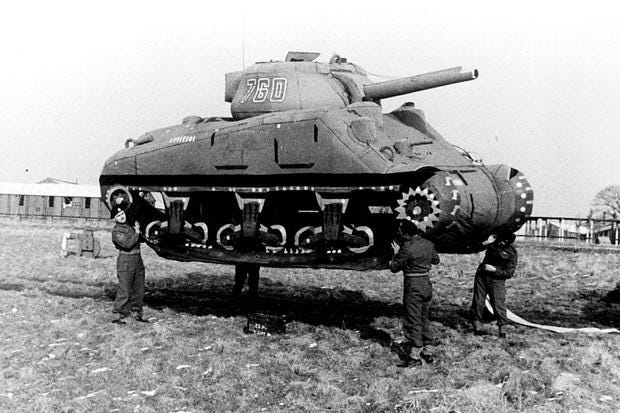

To pull off the deception, the Allies had false reports of the bad behavior of foreign soldiers printed in the press, made false patches and heraldry items for the fake unit designed. In all ways, this deception was pushed into the Germany intelligence networks in the hopes of convincing the Nazis that the invasion would occur anywhere else. In the end, the friction and fog this added to the war helped protect Allies forces on the beaches of Normandy.
Deception, while not the main objective for a military, can protect and conserve forces. Deception is a low-cost way to create time by forcing an adversary to misallocate collection, targeting, and decision bandwidth. WWII was largely contingent on radio intercepts and human intelligence. Today, ISR, space, and cyber capabilities are layered on top of more traditional collection. In this environment, the PLA is showing that it is focused on deception.
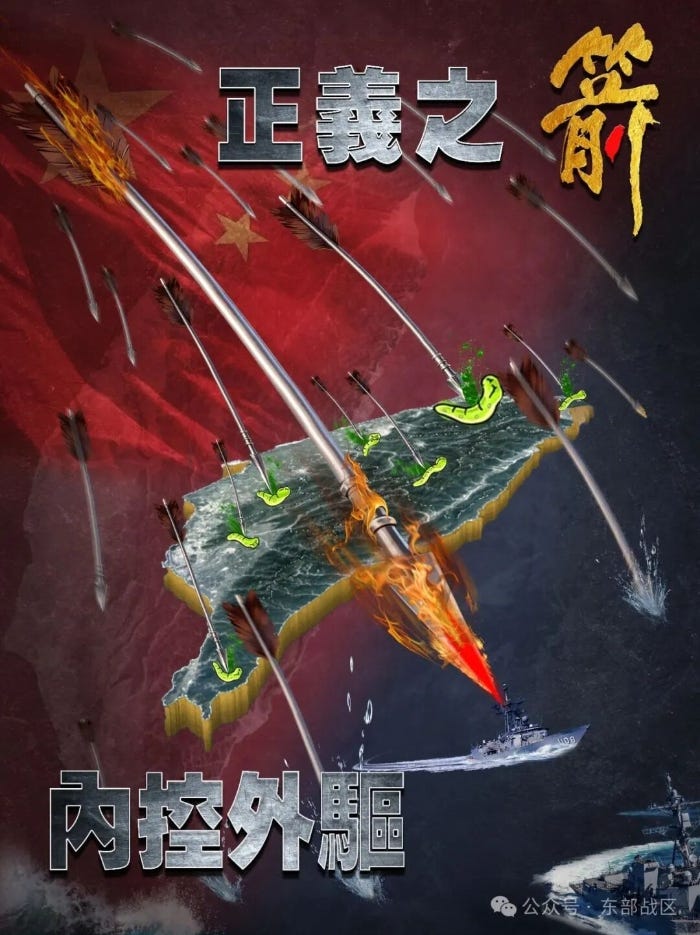
On December 29th, China’s PLA and PLAN started a massive exercise around Taiwan. The PRC is calling this operation Justice Mission 2025. It is interesting for several reasons. It is out of the normal exercise window, and it is the first exercise under some new PLA Eastern Theater Command leadership since Lin Xianqyang was reportedly detained in March, along with Rocket Force Commander Wang Houbin, who had only been in command since 2023. The exercise is in keeping with the maximum pressure campaign on Taiwan. The PRC is claiming it is the largest they have conducted to date. It also offered the PLA and PLAN months to reset and test again during the good weather months. And if the PRC’s intentions with Taiwan are unclear, their propaganda makes it clear. They depict green bugs on Taiwan being skewered by arrows, an obvious reference to the DPP and their missile forces.
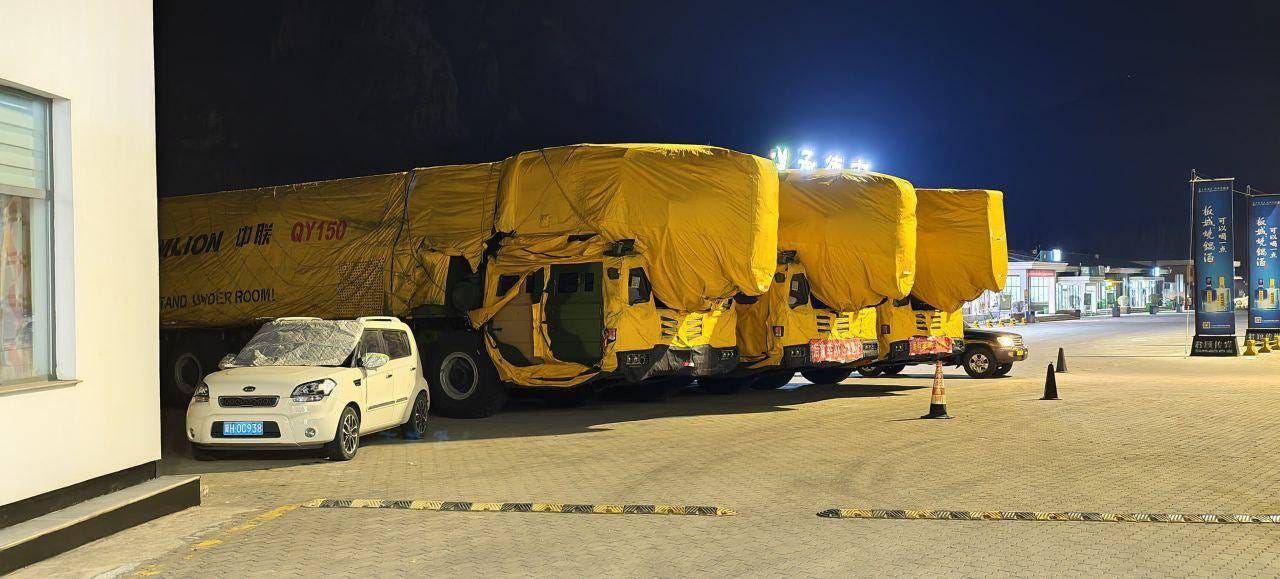
The propaganda and timing aside, another interesting thing crossed my feed yesterday: the PLA and Rocket Force’s use of deception. The PLA is disguising some mobile ICBM launchers as Zoomlion cranes. Zoomlion is a Chinese heavy construction equipment manufacturer. They make tower cranes used in construction across China. Up close, as shown in the photo and video below, it is easy to see it is not a crane, but from ISR or airborne and space-based surveillance it is much harder. This cover breaks up the silhouette. This increases the difficulty in tracking and targeting these launchers. When paired with the PLA’s recent demonstration of their container box missile launcher ship, you start to see that, for the PLA, deception is part of the point. They want to obfuscate and raise U.S. costs as much as possible.
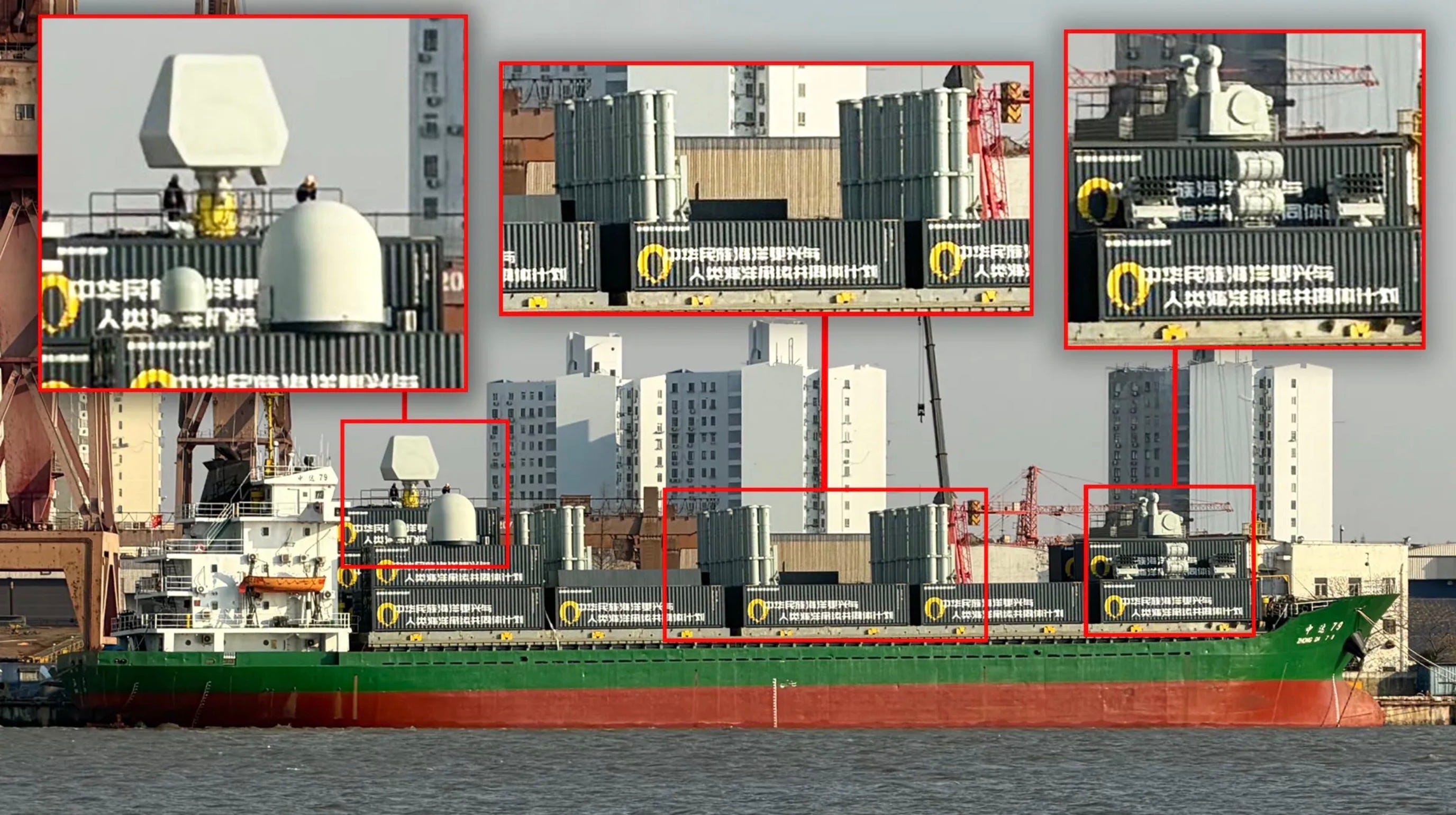
Operations Fortitude and Bodyguard were strategic deception. Disguising ICBMs as cranes is more about denial and camouflage. Despite the differences the objectives are the same, create time and decision space. Anything that distracts, slows responses, and sows doubt creates time. Time is a valuable resource in a Taiwan invasion scenario.
What the U.S. should learn from this is that low-tech means of deception work and are necessary. There is value in deception. There is even value in your adversary knowing that some of your plans involve some deception, because it makes them distrust their own analysis. Winning in future wars is going to look a lot like winning in past wars. Mass, intelligence, deception, and risk acceptance will all merge.
I’ve talked about mass before, as have Tony Stark and Secretary of Defense Rock. What is more attritable that something designed with the goal to deceive? In part, the benefit to deception is that it offers the U.S. a place have some asymmetric advantages. One of the goals of military deception is to trigger a an adversary to do something, even if that something is nothing. This means the U.S. could cause the PRC to expend resources to counter things that are ephemeral.
The counterargument here is that ISR and AI fusion will make this type of deception impossible or impractical. Perhaps, but AI is not the decision maker. It’s important to recognized that Operation Mincemeat, Fortitude, and Bodyguard didn’t fool all of the Nazis. They fooled the decision-maker. In the end, that was the whole point. Right now, no system is standalone. There is no single source of truth in intelligence. So any deception offer asymmetry because it causes doubt.
Asymmetry has to start being a focus for the U.S. military and industrial base. The PRCs willingness to invest state resources to catch up is a weakness that can be exploited.
Really liked this framing: deception is not a sideshow, it is the product.
Your WWII examples (Bodyguard/Fortitude/Mincemeat) underline the point that you do not have to fool everyone, just the decision-maker long enough to buy time and force misallocation. The modern parallels land for the same reason: if mobile systems can plausibly look like construction gear (and “seeing” stops equaling “knowing”), then uncertainty becomes a weapon.
No Shots Fired tie-in: this is deception as a peacetime cost-imposition tool. Turn every contact into a “maybe” and you force the other side to burn ISR, posture, and caution daily—slower decisions, more friction, less initiative—without firing.