
Drones: Short Term Urgency vs. Long-Term Vulnerability
Why we have to think more long term

One of the increasingly loud drumbeats coming out of the Department and from users is the need to get commercial off-the-shelf (COTS) drone solutions into the hands of warfighters today. The U.S. Naval Institute just published an essay from a Marine captain that discusses exactly this. I sympathize with him. He is looking at Ukraine and seeing its ability to employ cheap drones that, in the beginning, were largely made with Chinese components, and use them to beat back the Russians. When you see that, you want to ensure your side can do that as well. The issue with the article is that he misunderstands why U.S. drone capacity will cost more if we want it to exist during a conflict.
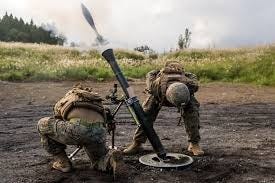
The author sees the problem. U.S. Marine Corps Littoral Teams are outranged and outgunned by potential adversaries. This is a risk to his forces today. Marines are using 81mm mortars, with a max range of 6 km, against potential enemies that could deny beaches from 12 km away. His solution is commercial FPVs. He describes the “defense establishment’s” resistance as arguing:
that relying on commercial-off-the-shelf drones would introduce unacceptable vulnerabilities. Skeptics note that "drones bought off store shelves" lack military-grade encryption and hardening, making them susceptible to advanced electronic warfare.8 However, this perceived fragility is offset by the disposable nature and low cost of these systems. The Marine Corps' modernization roadmap emphasizes the need to rapidly field a "low-cost, air-launched family of loitering, swarming munitions.” Instead of relying on a handful of highly protected assets, units could use "simple and relatively inexpensive systems" to overwhelm adversary EW through mass, turning unhardened platforms into a highly adaptable swarm capability.
There are several issues with this characterization of the discussion. One reason I want to highlight this piece is that I want to see young officers and NCOs writing. This captain is writing and thinking about future force structures, which is great. However, those ideas should be pressure-tested because captains eventually become colonels and generals. If the misconception of why we have the NDAA for drones is allowed to fester, it makes it hard to engage with partners, including the defense establishment. Whatever the defense establishment is, it is a group of people trying to build for warfighters. The issue here is that the solution to this range problem is not as simple as “buy COTS drones.” The cheap COTS drones are, by and large, built with parts sourced from vulnerable supply chains.
Supply chain security is the first reason the U.S. military should and will pay more for drones in the short run. This makes sense when we think about the economics. U.S. workers make more than Chinese workers; therefore, U.S. and allied secure supply chains cost more than outsourcing to Shenzhen. The Pentagon should not simply be buying COTS solutions for drones because the majority of drone manufacturers are not U.S.-based and do not have secure supply chains. This is why the U.S. required the purchase of critical components through NDAA compliance. Could the PRC disable all of the cameras or take over drones if we used non-NDAA-compliant parts and systems? Maybe this is a real vulnerability, maybe it is not. Basing doctrine and fires on devices that are reliant on PRC-controlled supply chains is absolutely a vulnerability. If we do not think it is, we have not been paying attention to the PRC’s willingness to use supply chains to its advantage, from critical minerals to magnets. The U.S. should not base any of its ability to generate combat power on an adversary’s production capacity.

The other issue is that mass alone does not overcome electronic warfare capabilities. That actually requires increased cost. Whether you fly one, 100, or 1,000 FPVs at an emitter that is blocking their current comms, you are likely to lose them. Getting past that requires directional antennas, frequency hopping, AI, computer vision, fiber optic drones, and a system that can coordinate all of this to ensure the right mix of capabilities is available. This is one advantage that the U.S. combined arms doctrine supports. Unlike other forces that are solely reliant on their FPV capabilities, with limited support from adjacent fires, Marine littoral doctrine was, and is, based on a high volume of joint fires supporting their movement. That calculus may be changing, and may have already changed, but that is one reason it is not on the Littoral Team alone to neutralize threats 12+ km from the shore. In fact, being a sensor for other shooters is a core part of the design of the Stand-in Force.