
Our Fathers Lied
Why those closest to war see it most clearly

Soldiers in the U.S. have not always been festooned with garlands and honors. I am not even talking just about the post-Vietnam soldiers. Those familiar with conflict see war, and, by proximity, military service, as both horrible and necessary, while those at a distance see only an abstraction. In my lifetime people have described the bulk of the men and women who serve as little more than the great unwashed masses. (See: The New Republic, Sojourners, Inequality.org) The people who would join would have to be those without options. I do not agree with this. While economics play a role, there are plenty of people who could join the military and choose not to despite their clear economic incentives. Many want adventure and to be on their own, and some, and this is a smaller few, hope that they get to go into a war. This is what the poems, songs, and stories are about.
One of the defining features of patriotic writing is the idea that military service and fighting for one’s country is a virtue. You see ideas around the positive nature of service, and often the need for compulsory service, resurface in countries as distinct as Russia, Britain, the U.S., and China over time. Starship Troopers makes a core argument that service should be core to citizenship. These ideas have a deep and lasting impact on our society. As LastBlueDog wrote in his recent Progressives Don’t Understand Masculinity, war and military service have an essential male quality that offer men status in society, event today. We are attracted to stories of the warrior though we often revile the atrocities committed during fighting.
I think that war is seen in a positive light because of both its risks and the fact that it is by and large fought by those who cannot and do not make the decision to go to war. Why we fight, not just who fights, should be the core focus of any analysis of war. The why is what is important. It is also what can change the most dramatically due to personal circumstances. A classic example is the change in Rudyard Kipling during World War I.
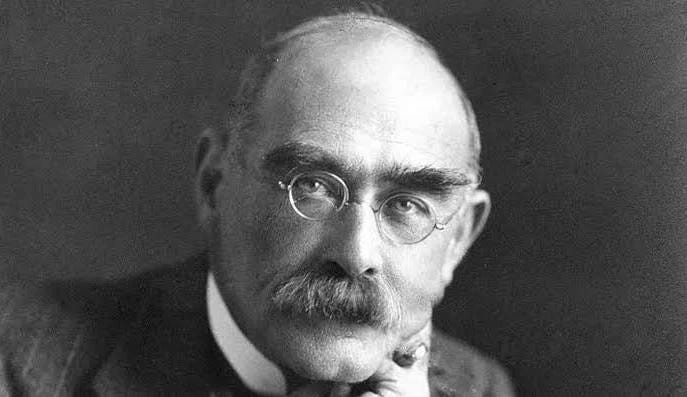
In 1919, Rudyard Kipling wrote Epitaphs of the War. Contained among them is perhaps the most scathing take on World War I written at the time.
If any question why we died,
Tell them, because our fathers lied.
It’s important to understand what led Kipling to write this and who he was in British popular culture prior to writing it.
Kipling spent a long portion of his literary career writing about the Empire as a force for good in the world, how military service was a patriotic duty that was necessary to sustain the empire and core to British identity. His novels and poems often engaged with the age of empire. In Kim, he follows a young Irish-Indian boy who becomes a spy for the British Secret Service. Soldiers Three is a collection of short stories that follow soldiers in colonial India, and in Barrack-Room Ballads, he captures the dialect of the common soldier in ways that are still used today.
Kipling, like some of today’s commentators, saw military service as core to teaching and testing the range of emotional control, endurance, and integrity under extreme pressure that are necessary in society. In fact, at the outbreak of the war Kipling celebrated the idea of the “iron sacrifice” that Britain was required to make to defend Europe and the world from the threat of the Germans. Yet, when we turn back to “Common Form” and Kipling’s other post-WWI writing, we see a man who is changed.
In 1914, Kipling had a 17-year-old son called John “Jack” Kipling. Jack was every bit his father’s son. He wanted to join the Army or the Navy and serve Britain. He attempted to go to Sandhurst and become an officer, but the British military barred him from commission because of severe near-sightedness. Kipling—both Kiplings—would not accept that outcome. Rudyard Kipling used his considerable name and friendship with Field Marshal Frederick Roberts to get Jack a commission in the Irish Guards. This was August 1914.
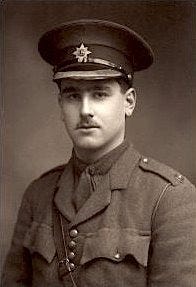
Jack and the Irish Guards arrived in France in August 1915, on Jack’s 18th birthday. In September, at the Battle of Loos, he was wounded and went missing following an attack on German positions. Jack died in France, fighting a war of attrition, trenches, steel, and barbed wire. As a father, I cannot imagine the impact that this would have on me. I would be beside myself.
Kipling may have been as well. He clearly grieved, but he also turned against the war. It is easy to dismiss Kipling’s early work as that of a man removed, and to say that only after the horrors of war touched him personally did he see the war as a terrible thing. I think this is overly simplistic. There are plenty of men who see the horrors of war and still think it worth paying. However, Kipling came to believe that the war had been one more of choice than of necessity. This is a narrative that has grown in modern military histories. Christopher Clark’s The Sleepwalkers: How Europe Went to War in 1914 highlights the many missed opportunities that could have prevented the war.
Still, Kipling thought the war was worth fighting. More importantly, he believed that any war that is being fought should be fought with a view on winning. Kipling came to write and make the public aware of the sacrifices British soldiers and sailors made while simultaneously holding politicians that failed to prepare the nation for the trials of combat to blame for the length of the war and loss of a generation. These were politicians that dreamed up easy success without understanding the realities of conflict. Kipling also attacked generals that left soldiers to “die in their own dung.”
It is often the people who are the most directly impacted by war who see both its utility and its horrors as two sides of the same coin. Too often, war is thought of in the abstract. It is something that can wash a person or a country in glory. The truth is more complex. As Sherman said:
“I am tired and sick of war. Its glory is all moonshine. It is only those who have neither fired a shot nor heard the shrieks and groans of the wounded who cry aloud for blood, for vengeance, for desolation. War is hell.”
Despite the hell that he lived through, Sherman never regrated his actions in the Civil War. He, like many, felt that the most just war was a short war, and the best way to make a war short was to be brutal. This is the hard reality that many face. War is brutal, there are still things that are worth going to war over, but the use of war should be measured and a last resort. This is not to say that you must be brutal. Just that once fighting is started it needs to be carried out swiftly and against the aggressor, not civilians.
My family has served in uniform in some form or fashion for generations. They endured the post-Vietnam stigma and continued to hold their heads up. The reality is that service in the armed forces is part of our family. It’s from that position that I want a society that thinks critically about war and warfare. Like all human endeavors war is both simple and hard. It tests people, will, resolve, and reasons. It also requires deep thought an analysis. What is most pernicious about warfare is that it is the fathers who decide and the sons who die. Something Kipling came to see only too late. We should look critically on war and why we fight, because it is something that is worth our attention as a citizenry and we should not accept uncritically the pronouncements of anyone.
> Starship Troopers makes a core argument that service should be core to citizenship.
Maybe it's time for me to read the Heinlein; I'm only familiar with the Verhoeven film version. My impression from the film (since I cannot speak about the book) was that the argument in favor of military service had been totally corrupted by a warmonger mentality that prevented most from seeing it clearly. Then there's the strangely vulgar visual satire on masculinity in how the film depicts the Queen Bug as ... you know ...
By coincidence, https://www.thepsmiths.com/p/review-anabasis-by-xenophon yesterday published another lens on masculinity and war. I realize it's about time I read Xenophon, too. The perspectives you've shared from Kipling sound very familiar to the usual liberal discourse I'm familiar with. Xenophon sounds as about wild as Johnny Rico, and the background politics equally deceptive.